
Astrologer, published author, conference presenter, world traveler, founder & editor of Crone Chronicles: A Journal of Conscious Aging (1989-2001) , and founding visionary of Green Acres Permaculture Village (2010 to present).
About 18 people showed up for our Halloween Party Thursday, including dear Andreas who, after 4 years with us, has now moved to Ireland, and a new position as professor of piano. We brought him and his puppy Butch in by phone.
I had promised myself to go as a “star woman” this time, rather than going along with the prevailing Halloween pretend-Evil that has actually morphed into obviously real Evil during these strange years. Oh, and by the way, I forgot to mention in that post that perhaps the most obvious sign of F.E.A.R.-based all-year-long Halloween is that we’re still “mandated” to wear masks in public!
Some people at our party weren’t dressed in costume, so I said, geez, you’re coming as yourself? At least go out to your cars and get your masks! Of course I was joking. But you never know.
In any case, I was pleased with my star woman costume, which consisted of a Dollar Store star sticker pasted to my forehead, white pants and top that I used to wear to Dances of Universal Peace events (hopefully they will return sans masks), and a hand-woven and designed robe by a very talented woman I used to know in Jackson Hole. I used to don the robe when I’d give formal presentations on astrology. Oh yes, and an amber necklace, gifted to me by my dear mother-in-law probably 30 years ago. All this coupled with sandals and a pair of black socks depicting the solar system. But my crowning glory, which I decided on at the last minute, was a Peruvian headdress that I got in Peru many years ago, and that I think might be something which is supposed to belong to a shaman. At any rate, the entire get-up worked as a unit, and when I announced, somberly, to the assembled that I was a Peruvian Star Woman, and that they were to address me in the third person, someone asked, “Is there really such a thing as a Peruvian Star Woman?” and I answered, “She has no idea!”
 I created “Peruvian Star Woman” from the interaction of my fertile imagination with the “stuff” I have at hand. Presto. Instant respect, even reverence! Pretended, of course, and matched by my pretended haughty attitude Thursday evening. Great fun.
I always tell the young ones around me that though reality appears to be very structured — and so, please stay in the line, and these days, six feet apart! — reality is actually quite malleable. Most seemingly eternal structures (rules, roles, regulations, institutions, etc.) are human-made. And so can be undone, and redone, by humans. So, for example, if you think you fucked up a food recipe, no. You didn’t fuck up. You changed the recipe.
So too, my son Colin Cudmore, an inventor. See Garden Tower Project. Most people, including him, think that his inventiveness is his great talent. But I’d say that prior to any of his inventions, it’s his fertile imagination that formulates questions others don’t think to ask. These questions he then turns into problems, which he knows he can solve, given time, attention, and his deep familiarity with materials used in the 3D world. He told me yesterday that when he goes for patents, and he has many of them, unlike most inventors, there’s never much research required, in order to tweak the invention so that it won’t copy others. Thus the patenting process, for him, is not nearly as expensive as it would otherwise be.
I knew I had a kid whose mind and imagination were free to roam wherever, back when he was three years old and asked me, “Mom, which is more real, my dreams or yesterday?” To which I responded, “that’s a really good question, Colin!”
In fact, I used his question in the finale to the drama of my PhD dissertation examination. One of the professors asked me: “Well, since you think that the line between fiction and fact is very thin, give us an example.”
(Remember, this was 50 years ago, and though the “thinness” of this “line” appears obvious now, it wasn’t then.)
“Well,” I responded, “my young son Colin asked me recently: ‘Which is more real, my dreams or yesterday?'”
How could anyone follow that response with another question? In fact, that response closed down the examination — after only 30 minutes. (It was supposed to last two hours.) After a minute of dead silence, I hear “You may go now,” from the chairman, clearly flustered. The committee consulted without me for a little while, and then awarded me the degree.
So, my Peruvian Star Woman, is she real? Is she a dream, or is she just something I wore yesterday.
That quote has a nice ring to it, eh? From @docMJP on twitter.
I focus on Fauci as today’s local paper reports: Indiana “expects to receive more than 200,000 pediatric doses of the Pfizer-BionTech COVID-19 next Monday and Tuesday, said Indiana chief medical officer Dr. Lindsay.”
Note:
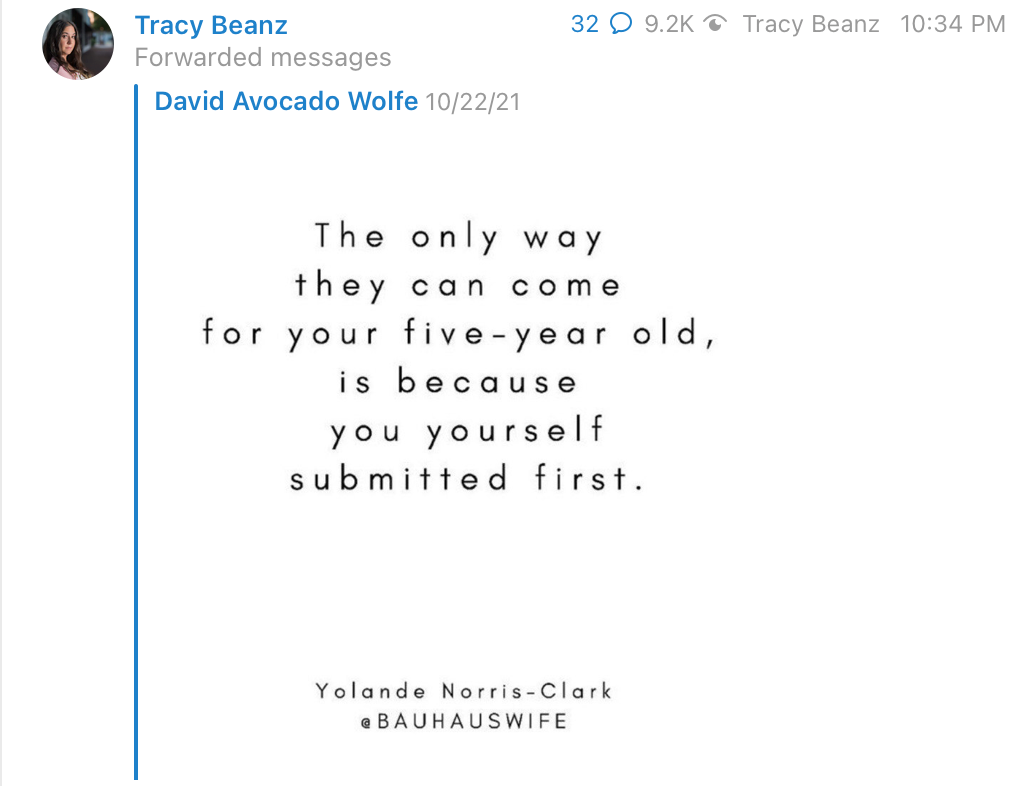
Is it any wonder that open, spirited rebellion against the so-called “vaccines” began with parents speaking up to local school boards all across this nation?
Here’s one mother who changed her decision to vaccinate her kids, and why, and how her story is being buried.
Exclusive: Why A Mother Changed Her Decision to Vaccinate Her Kids Against COVID-19
Another local story today talked about the new, extended county mask mandate, “set to expire right before midnight on the Wednesday that Monroe County’s COVID-19 positive case rate drops to less than 50 cases per 100,000 residents. Right now, the county has 92 cases per 100,000 . . .”
Never, not once, ever, does any such report refer to the amplification number for the PCR tests which, when “positive,” are considered “cases” — even if a person is and remains symptomatic. Anyone who is following the PCR scam (at the very root of the plandemic scam) now knows that anything above 35 cycles will likely show a high percentage of “false positives,” due to the fact that only below 28 cycles, will actual live viruses show up. So, when they want to ramp up “cases,” they just ramp up the number of cycles. Here’s compelling testimony from a pulmonary nurse who finally quit, unable to continue once he realized he was “murdering” patients.
I repeat: are the number of cycles ever noted, or discussed whenever there’s talk of “positive case” rates? NO.
But what really got to me today, was this:
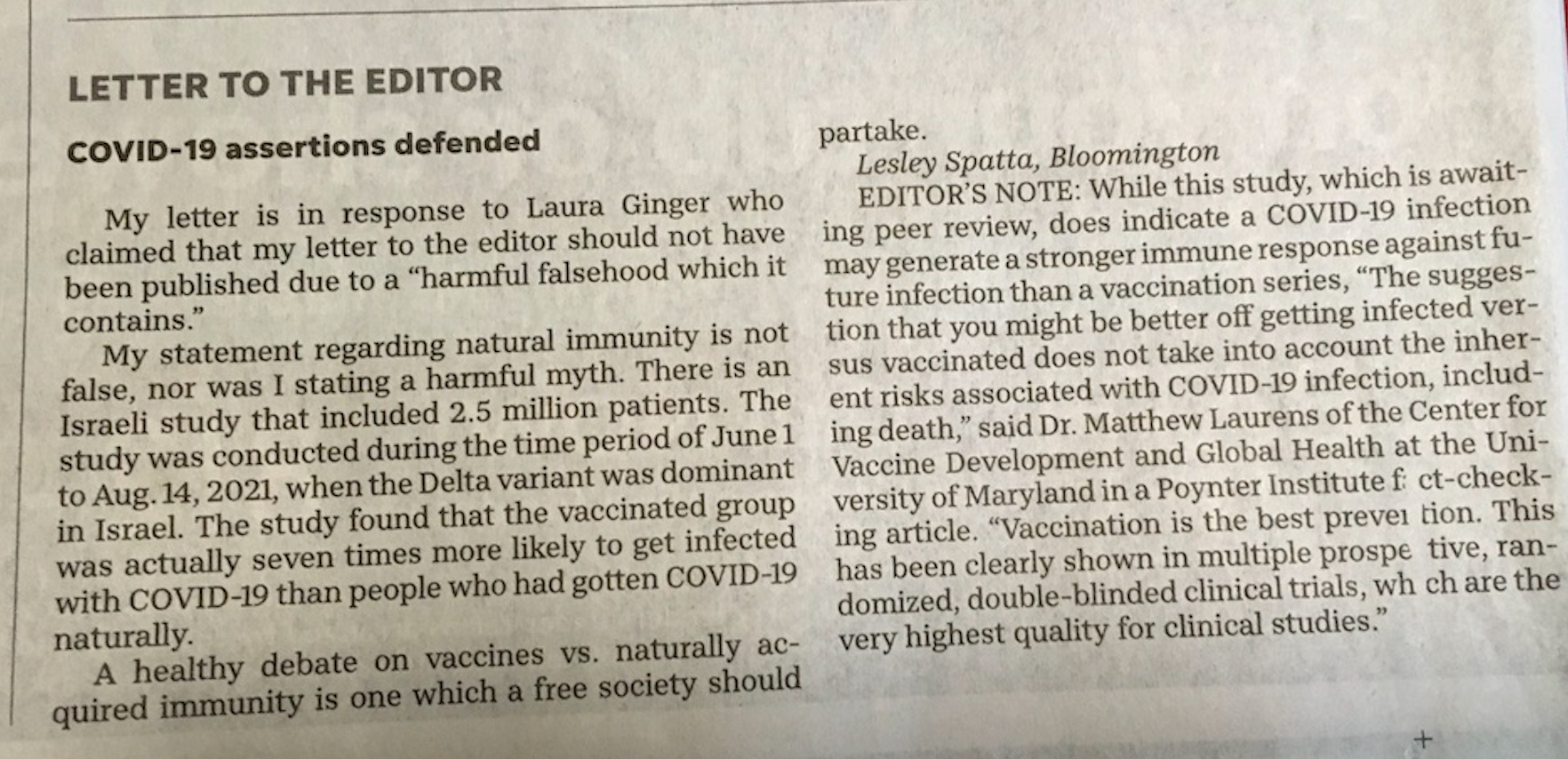
Somehow, the “authoritative” tone of the Editor’s “correction” really got to me. Is this because my own Moon at 23° Taurus sits exactly where Tony Fauci’s Uranus is, and opposes exactly, his Scorpio Mars??? Grrr . . . Makes me want to scream. (I looked at his chart here.)
With all this in mind, I invite you to read the following extraordinary article, all the way through. It held me spellbound. The author documents, through personal experience, what happens when we give over the authority of our own sovereign soul to others, the ones they call “experts.” Which means in turn: that we must either uncover (for the first time) or return to the authoritative center of the self, each of us, if we are to see our way through this unprecedented collective global psy-op that has befuddled so much of humanity.
How many of us need to firmly recognize ourselves as truly sovereign souls in order to anchor the total transformation needed? I don’t know. It may be only 5%! In any case, let us center ourselves, root ourselves into this Good Earth below while receiving abundant blessings from the Heavens above, as we open our Hearts to all humans, LOVE them unconditionally, even the Tony Fauci’s of the world whose egos’ craven need for greed and control render them puppets of possibly even off-world forces.
”And you? My teacher looked up, his left eyebrow arched, pencil poised. 'I want to do a paper on the concept of time.’” I mumbled, timidly. 'Time?' He sniffed. “I wouldn’t touch the subject. Too difficult.” — AK, 1967
Ph.D. 83
Astrologer, published author, conference presenter, world traveler, founder & editor of Crone Chronicles: A Journal of Conscious Aging (1989-2001) , and founding visionary of Green Acres Permaculture Village (2010 to present).
Copyright © 2025 All rights reserved.


[…] during the recent Clancy drama, I was enveloped in…