. . . and noticing how the details of the book internally resonated . . .
Yes. Very much so. In fact, all the way through, PARADISE NOW: THE STORY OF AMERICAN UTOPIANISM, by Chris Jennings, ignited memories I had completely forgotten about. In other words, I did not know the memories were even in there, waiting to be unearthed!
Just how did this happen? Well, I realize now, utopia has always been my guiding star, my lifelong goal, inspiring and/or “figuring out” a way of life that dynamically and harmoniously includes the utterly divergents strengths of fractious individuals and shared community, or one might say, philosophically, how to combine the One and the Many.
And, since I live in the U.S.A., “land of the free,” to which intrepid and brave Individuals migrated, first from Europe and, especially now, from elsewhere, the pole not exactly missing from the equation, but certainly de-emphasized, is Community.
On the other hand, I’ve been deeply troubled by the current politics that surround immigration, how this country has been overrun by those who are given free stuff if they do move here and thus expected to vote in a certain way; in other words, come to America, and Community, for you, is guaranteed!
“Socialism,” in all its forms — I tend to keep a desktop folder with socialist memes. For example, these two —


Is not my bias obvious?
So yes, socialism does seem to be what this country is heading into, or at least was, until the advent of Trumpian individualism. And yet, to me, both selfish, greedy capitalism and so-called selfless, but actually mind-controlled socialism/ communism are one-sided. How to achieve a dynamically harmonious balance between the two?
So you might wonder why I picked up a book that examines five examples of 19th century socialism, all of them stressing life-in-common, including, for some, the dispersal of all private property, including money, to the community. What is it they say now? “You will own nothing and you will be happy?”
For yes, that’s what they were about: how to actually engineer, or invite, or persuade individuals to join their lives to such an extent that we free-thinkers, in late 2025, would be appalled to even consider this an option.
And yet, community has always held the patina of safety, of a way of life that, because it is shared, both in its joys and its sorrows, feels good.
My own philosophy, however, has always been, for over half a century now, informed by both Jung and astrology: We are here in bodies on planet Earth to fully actualize our extraordinary individual potential (as shown in the utterly unique configurations of our natal charts). And how do we do that? By interacting with others and the ground beneath our feet!
Nobody grows in a vacuum. It’s impossible. We need especially the frisson of those whom we tend (whether instinctively, or via conditioning) to hate, despise, think beneath us, or envious of those above us, etc. Each time we find ourselves riled up emotionally, we need to ask: what in me am I projecting upon this other person? What qualities that I think I detect in them are actually, or also, in me? Qualities that I tend to deny? In other words, Shadow Work.
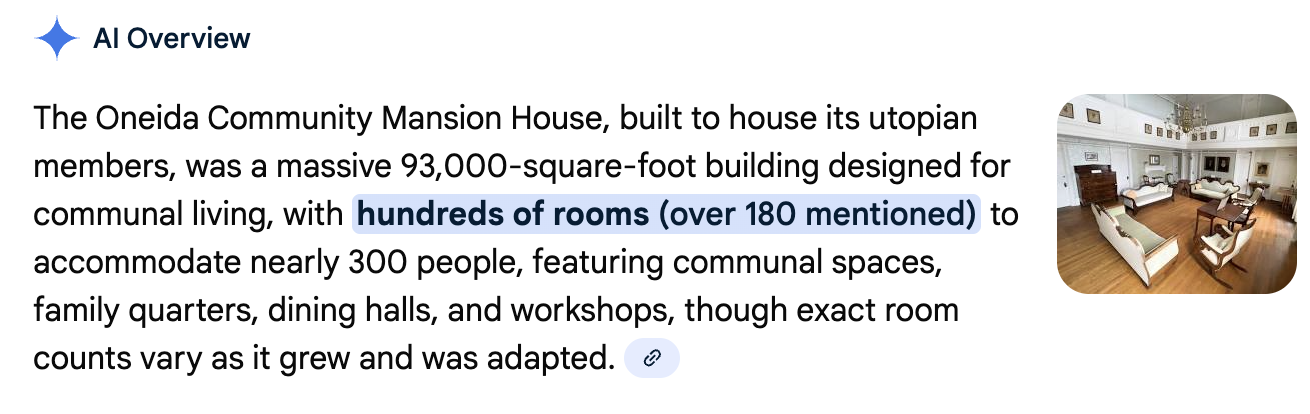
One of the five communities dealt with in this book, Oneida, which lasted longer than any of the others, had a weekly evening practice that likely helped them to tolerate their very crowded conditions as they lived in The (very large) Mansion House.
How large?
Rather than pore through the book to find the exact page, I just searched for the answer, and bingo!
This weekly practice was to gather with the express purpose of criticizing each other. Everybody got a turn. No critique was “too much.” Both the trivial and the serious. While your face might burn when it was aimed at you, your turn was just around the bend.
But yes, like the other four communities, after 30 years Oneida died. And this book traces the conception, birth, growth, maturity, and dying process of each of them.
While the Shakers, Owenites, Fourierists, Icarians, and Perfectionists [Oneida] had different visions of the coming paradise, they all shared the belief that some specific, ideal social order exists. Whether or not they saw God or Reason or Passion as the author of that ideal order, they proceeded from the assumption that humankind is somehow meant to live in utopia.
This book is especially good at tracing the back story of how each community began (with a charismatic leader, Christian or secular) determined, not just to imagine, but to actually establish a tiny social/material structure and process for group life that would serve as a template, an example for the entire world. To this end, the leader bought land, or had it bought for him, in wilderness usually, though two of the five bought out the physical structures and layout of an already existing “community” that had either moved on (New Harmony: (Owenites), or died out (Nauvoo: Icarians).
The point is, this was not just hopeful dreaming, this was actual hands-on, learning how to farm, constructing houses, fences, small businesses, a mill, etc. Not easy. Not always fun (though more fun at some places than others; in fact Fourier was determined to have all labor be fun).
Because of their small scale and grand ambitions, these communities offer an unusually clear window onto the practical working out of various social theories. Every community, utopian or not, is composed of notions about how people ought to live together. (p. 19)
As I poured through the thousands of fascinating idiosyncratic details the author researched and ran with (often ironically, or otherwise gently making fun of), I found myself dreaming, imagining . . . my own visions for community life drifting back into view.
That was the first really extravagant vision of giant apartment structures that could be completely reimagined as actual living communities, rather than just individual apartments where people usually just pass by each other in the hallway with only, maybe, a shy, or curt, hello, on the their way to their own private, lonely, lair.
Every time I see an apartment building, I cannot help but reimagine its use . . .
Here’s a more recent vision: entire square city blocks with homes along all their edges establishing an actual commons, with gardens, playground, etc. inside, rather than all the separative fences.
Here, now, at home, our tiny three home Green Acres Permaculture Village, with neighbors nearby joining our weekly work parties and weekly Community pitch-in Dinners for one and all.
And of course, given my own predelections, I imagine little villages like ours, many of them throughout this large (460 small homes) neighborhood, eventually networking with each other with paths throughout, not just on sidewalks parallel to streets.
I imagine all suburbs transforming themselves in this way.
And even further: since this is an academic town, with our Green Acres neighborhood abutting Indiana University, how about programs in psychology, sociology, city planning, architecture and design, etc. etc., all utilizing Green Acres as a base.
I simply cannot help it. It’s who I am. A dreamer, a philosophical dreamer: how to work with the One and the Many, Individual and Community.
So yes, my own utopian fantasies have been ongoing, and constant.
The book’s author mentions, somewhat ironically, the two, opposite, etymological origins of the word “utopia”:
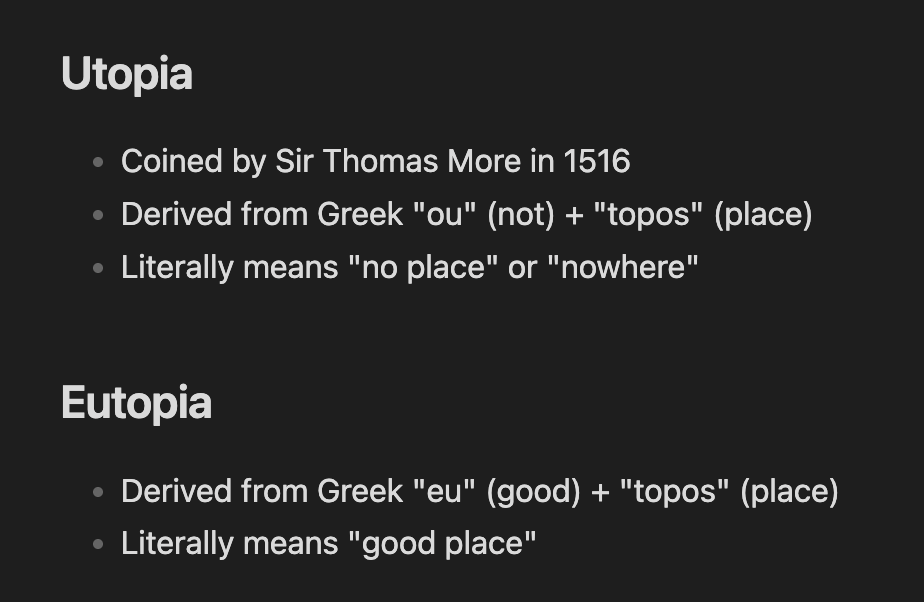
In other words:
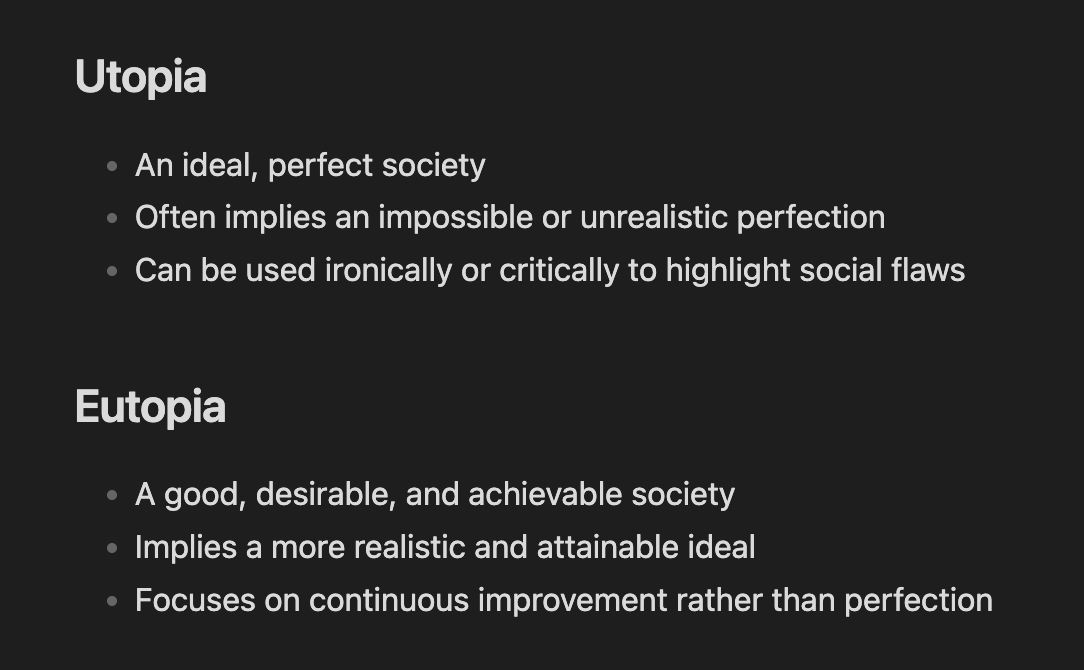
Whether or not each of the five communities actually focused on continuous improvement rather than near immediate perfection depended hugely on the character of its founder. Did he (or in one case, she) have a fundamentalist, dogmatic point of view? Or not. If the former, then eventual conflict with others was guaranteed.
I was almost as interested in how these communities dissolved, or were cut short, or fell apart, as I was in their birthing process.
I’m reminded of my own life. Its impermanence. As I head into its ending, which may be the next second (a heart attack, say), or may be in ten years, likely no longer. In my 84th year, I am clearly on the other side of maturity. It’s well, to keep that in mind as I go about my days.
”And you? My teacher looked up, his left eyebrow arched, pencil poised. 'I want to do a paper on the concept of time.’” I mumbled, timidly. 'Time?' He sniffed. “I wouldn’t touch the subject. Too difficult.” — AK, 1967

Ph.D. 83
Astrologer, published author, conference presenter, world traveler, founder & editor of Crone Chronicles: A Journal of Conscious Aging (1989-2001) , and founding visionary of Green Acres Permaculture Village (2010 to present).
Copyright © 2025 All rights reserved.


While you were reading PARADISE NOW, I’ve been listening to COSMOS AND PSYCHE, after listening to THE PASSION OF THE WESTERN MIND, both by Richard Tarnas. It’s been a crash course in the entire history of Western Civilization and then some! Totally immersive–with each book over twenty hours of listening. I just find it fun that we’ve both been engaged with this deep, comprehensive material the last while. Then again, your chart and mine are so linked. I had no idea you’ve been involved in over twenty intentional communities in your life. Wow. A ninth house Neptune at the Midheaven, indeed!