
Astrologer, published author, conference presenter, world traveler, founder & editor of Crone Chronicles: A Journal of Conscious Aging (1989-2001) , and founding visionary of Green Acres Permaculture Village (2010 to present).
Have you ever popped a boil on your own body? I have. Weird. And no fun. Especially the aftermath. That area must be cleaned and cared for, lest it become infected.
Humanity is now in the process of bursting a boil that has been slowly surging from underneath for years, decades, even centuries. It’s no longer news. It’s obvious. We are undergoing a massive, historic, collective purging of evil, worldwide.
Evil, especially having to do with children. Trafficking, torture, rape, murder, adrenochrome, MK Ultra, mind control, hunting parties, on and on.
For me, the discovery of this overwhelming evil goes back to the late ’90s, when I discovered Trance Formation of America, by Cathy O’Brien, who was first trafficked herself, as a child, by her own father, to Gerald Ford.
For me, this book plunged me into the first of many dark, difficult rabbit holes. Rabbit holes that I couldn’t talk about in public, lest I be considered crazy.
Those days are past. This ghastly and very public unrolling of what some of us have known for decades is so astonishing to me, that it feels like the prelude to a brand new beginning. To Death yielding Life! As ever. At least as long as we are in bodies, which come and go, rise and fall, like the tides. This is true, not just of the actual physical death of our bodies, but of the many little deaths along the way. A small or large plan, interrupted, failed; a supposed friend, dropping the mask of good. And then, inevitably, the slow or sudden wrenching recognition that these sudden switches entail.
None of us is immune to the continuous cycling of LifeDeathLifeDeathLifeDeathLife — a subject I wrote about in 1993, before I read Cathy’s book:
Meanwhile, here we now are, finally, smack in the middle of climactic, years’ long, collective purging of evil. It’s way too early to predict what comes next; just be aware that, like day follows night, and summer follows winter, life does follow death, always.
Here’s a current example of what our collective purging entails. By an independent journalist of long standing (and a dear neighbor):
https://crossroadsreport.substack.com/p/alan-dershowitz-was-debriefed

Even as the boil is released, the aftermath is critical. Life just doesn’t just instantly replace Death. Suffering does. Grief. The emotional absorption and integration of the horror. And then, inevitably, if we are strong enough, the awareness and integration of Darkness within ourselves. Only this integration, within enough of us, will ensure that humanity can not only survive but even learn how to thrive.
Let us take care. Let us take good care of both ourselves and each other.
Within the past year or two, I began to see references to the “Overton Window.” Hmmm. . . intriguing. What is it?

Hmmm . . . “Window of political possibilities.” What happens if we deepen its reach to include psychological, sociological, cultural possibilities? What would that look like? And why does it matter?
Think of yourself going around the world with a set of glasses on. These glasses measure your (deepened) Overton Window. Furthermore, you have no idea that you are wearing glasses. You think you are seeing “reality.”
Indeed, beyond the frame everything is blurry, or even, non-existent. You simply don’t see anything clearly except what’s basically, “right in front of you,” or, I should say, visible to your eyes, which, however, don’t move very far right or left, up or down. Nor does your head swivel. You’re chained to the Overton Window. Yuck.
Now deepen that thought. What if, everything you perceive in your particular Overton Window (the boundaries of which are shaped by all the influences in your life — both conscious or unconscious, subtle or overt, formally educational or otherwise) goes into your brain which itself has been shaped by the particular language you speak! So that what might be visible to a person who speaks Hopi, for example, is not by an English-speaking person. And it’s not just names, says Jean Piaget among others, with which we learn to denote “objects” out there, it’s also the very grammar that structures them into ways of making sense. The Hopi, for one, does not use the linear-causality-implying Subject-Verb-Object sentence structure. For them, “Billy throws the ball” is something like “there is a ball throwing.”
For linguist Benjamin Lee Whorf, whose book Language, Thought, and Reality, was first published in 1956:
“the structures of different languages shape how their speakers perceive and conceptualize the world.” — Wikipedia.
I remember how stunned I was to come across his writings, back in graduate school. And yet, I had been priming myself for just such a revelation, for years.
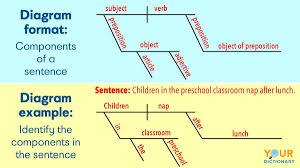
Back in “grammar school” (yes, that’s what they called it then, do they still call it that? Aha! Just looked it up. Originally designated as the type of schooling received by supposedly gifted students from the ages of 10 through 14) I loved diagramming sentences. (Just looked that notion up, too. Aha! while popular when I was young, by the 1960s and 1970s diagramming sentences began to be abandoned.)
I loved diagramming sentences because I truly wanted to grasp how language is structured to convey meaning. I could have asked a deeper question: what is the relationship between language and thought? But even the idea of that question didn’t rise up to awareness until graduate school. Not that I ever learned how to answer it! Frankly, that question is still there, making nonsense of any supposed bottom-line assumptions about how the world “should” be perceived. Nevertheless, my Sagittarian tendency towards dogmatism persists! Mea culpa!
Back to grammar. Hmmm. Are all grammar’s structured the same? According to linguist Noam Chomsky, yes. Their “deep structures,” while “surface structures” may differ, do not. In this view of a priori mental structures, Chomsky echoes the philosopher Immanuel Kant, for whom the framework of space/time was innate. 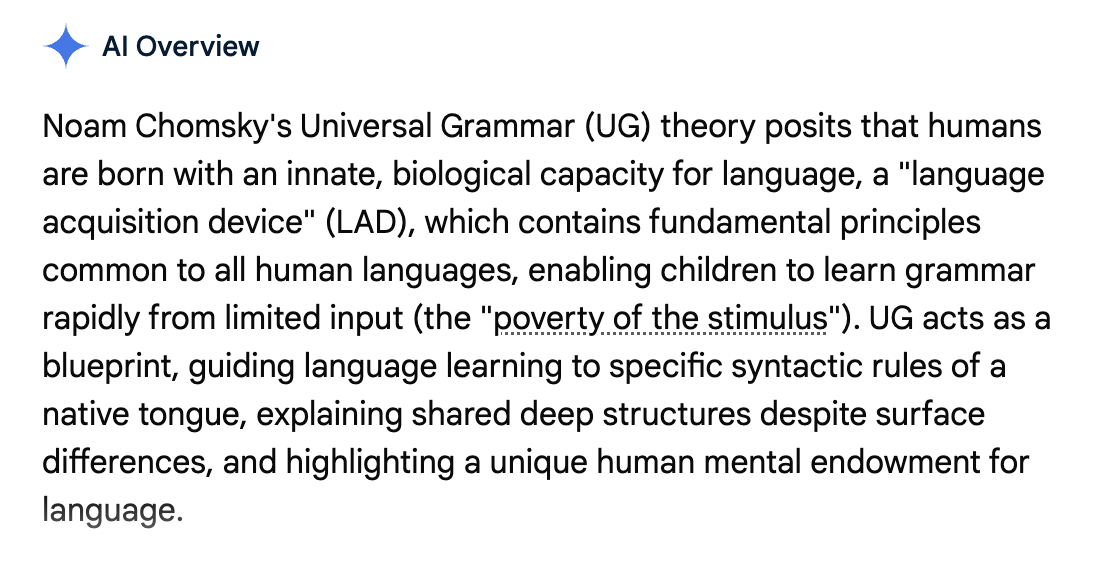
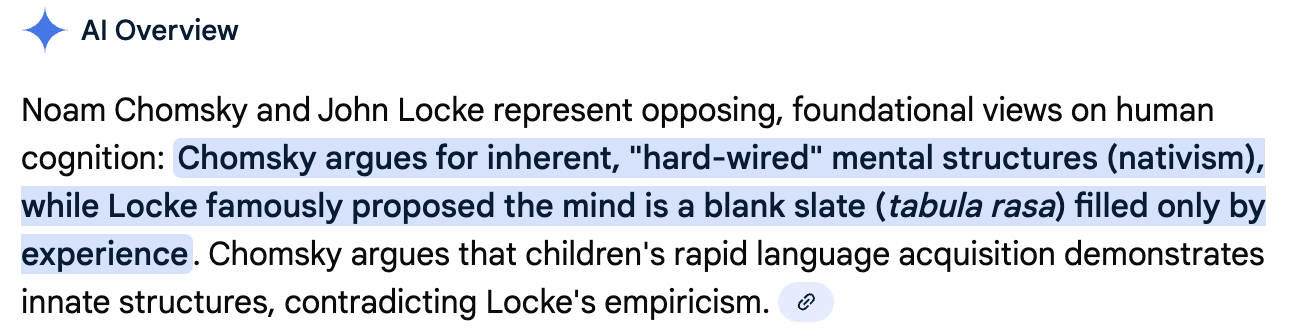
In other words, according to Chomsky, John Locke is wrong. There’s no such thing as a tabula rasa, a mind that is blank.
Okay, so what’s the difference between Chomsky and Whorf?
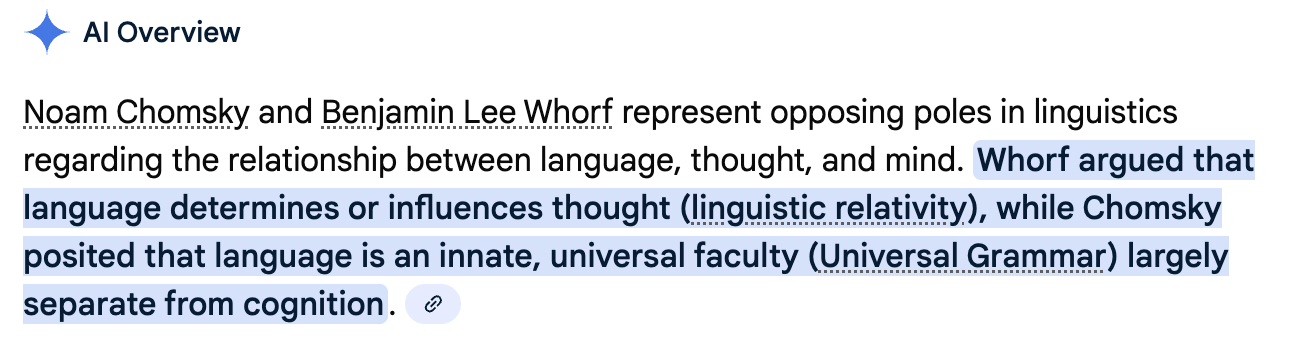
The point is, not only does each of us likely see through our own particular Overton Window (generalized from merely political), but our minds are structured by our own personal history to only see in certain ways.
And with that, all pretense at Objectivity disappears into the mist. As it should.
”And you? My teacher looked up, his left eyebrow arched, pencil poised. 'I want to do a paper on the concept of time.’” I mumbled, timidly. 'Time?' He sniffed. “I wouldn’t touch the subject. Too difficult.” — AK, 1967
Ph.D. 83
Astrologer, published author, conference presenter, world traveler, founder & editor of Crone Chronicles: A Journal of Conscious Aging (1989-2001) , and founding visionary of Green Acres Permaculture Village (2010 to present).
Copyright © 2025 All rights reserved.


[…] She sets the chart for Washington, D.C., which puts…