I was going to put up something on socialism vs. capitalism yesterday, but got quickly diverted by everything going on at home. But here’s the twitter post that got me going in that direction. Made me laugh out loud. 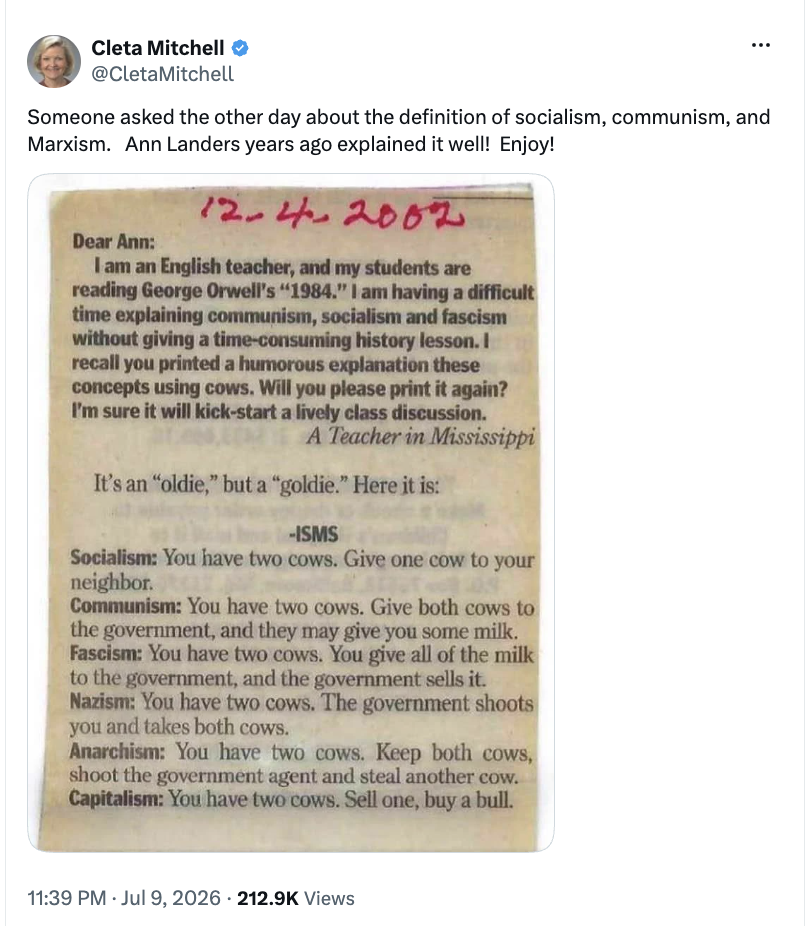
Then, this morning, while at the check-out counter in the nearby Dollar Tree store (for more twice-daily “treats” to satisfy 7-year-old “puppy” Scampi’s addiction to fierce chewing), and while I was busy taking 7 packages of treats out of the bag the clerk had put them in and stuffing them instead, one by one into my backpack — the man in line behind me (old, skinny, hauling several stuffed cloth bags, looking beaten-down by the world, wouldn’t make eye contact) — had his card “rejected.”
The middle-aged woman behind him, waiting for this transaction to end, with a composed face showing no emotion, looked on as the old man, flustered, embarrassed, asked the clerk what he should do with the stuff he had hoped to buy (I didn’t notice what it was), and she, empathizing with his plight, embarrassed for him, was trying to explain to him, pointing, “Put it over there,” etc., — when the woman behind him in line remarked, in an even voice:
“Just put it on my bill.” And again, “Just add it to my bill.”
Well, you can imagine the hoopla that caused within the man, and the clerk as well: “Thank you, thank you,” erupting over and over again from their mouths, both obviously surprised and full of gratitude.
I turned away at that point to leave the store, noticing how witnessing that encounter had suddenly shifted the entire world into blessing. And, made me feel guilty. “Why didn’t I offer too, or first?” Or, was I simply feeling competitive, ego involved?
But the lady who paid for the man’s goods did not make a big deal out of it. Not at all. I doubt she felt proud of herself for doing so. Maybe she just wanted the line to move along so she could get out of there faster? Possibly. And/or perhaps she had just spontaneously opened her heart to the man, obviously distressed beyond all measure. A fact that I, personally, did not really register until I looked back on the encounter.
I wonder how many spontaneous, or seemingly spontaneous gestures to help others are happening? In the Dollar Treat store, in my neighborhood, in Bloomington, regionally, nationally, everywhere fractious individuals live in fractious community? Wonder if more generosity, or less, than usual?
I remember back in 1974, when I was newly married to the man who had been my high school boyfriend 12 years earlier. I was back in my hometown, Twin Falls, Idaho, where he was the Editor of the local paper. While out riding my bike, I had been noticing the many ways passerbys help each other, give way to each other, smile in greeting hello. Then one day I after witnessing a particularly generous scene, I suddenly asked my new husband why his newspaper doesn’t report the good news? Why only bad news? To which he replied, “Because that’s what sells papers.”
It would be wonderful if someone would try to obtain metrics that show “unexpected, good deeds, gestures of generosity” in some location, for a certain amount of time? Would that be possible? For example, at Aldi’s. So many many times when I shop there I notice myself either offering or receiving this kind of generosity, when needing a quarter to get a basket. So many times we leave each other our baskets, smiling and waving “no” when the other offers the quarter in exchange. No. Pay it forward!
Aldi’s may indeed offer this kind of metric, if someone bothers to map it. Meanwhile, let us remember: generosity is an attitude, the attitude of Love, rather than Fear, and ultimately, its expression does not lend itself to being reduced to data points. And, these days during the likely final climax of materialism, which depends on the perception of scarcity, if Elon is correct and abundance is in the offing (search, for example, google’s Gemini AI: “Elon Musk on Scarcity vs Abundance”), it may be that pretty soon, such metrics won’t matter in the least. Everyone will get what they want. So the question is, when robbed of scarcity, when confronted with abundance, what will happen next. How much “stuff” do we really want, when so much of that stuff burdensome, and moreover, will no longer serve to create and maintain social hierarchy?
At this point, and for many decades at least, most humans have been indoctrinated into seeing the societal world hierarchically, with themselves at the bottom of the pyramid, numbed to their own latent aliveness, laboring ceaselessly for “the man,” with no recourse but starvation, death.
What happens if people are freed up to follow their own purpose? How many among us have ever even conceived of having one? Of seeing oneself as a true individual, with a life path as shown by our unique astrological chart, configured for that time, that date, that place? A chart our soul agreed to prior to birth: with the date, time, and place exactly needed to express our own unique nature, this time around, as it unfolds through time and space?
This kind of question is not usually asked. Not yet.
In any case, what the lady did in the Dollar Tree: would that fall under the rubric socialism or capitalism? Obviously capitalism. She did it, spontaneously of her own free will. Nobody asking, nobody expecting. And the result was what socialists often preach the absence of unless socialism is instituted.
”And you? My teacher looked up, his left eyebrow arched, pencil poised. 'I want to do a paper on the concept of time.’” I mumbled, timidly. 'Time?' He sniffed. “I wouldn’t touch the subject. Too difficult.” — AK, 1967

Ph.D. 83
Astrologer, published author, conference presenter, world traveler, founder & editor of Crone Chronicles: A Journal of Conscious Aging (1989-2001) , and founding visionary of Green Acres Permaculture Village (2010 to present).
Copyright © 2025 All rights reserved.


