Astrologer, published author, conference presenter, world traveler, founder & editor of Crone Chronicles: A Journal of Conscious Aging (1989-2001) , and founding visionary of Green Acres Permaculture Village (2010 to present).
All my life I have treasured close female friends. Starting with Mitzi in first grade, who challenged me to be brave (without her egging me on, I would never have tried to jump across that little stream), to Mary in junior high and high school, with whom I engaged in long conversations about boys; and to, especially, Claudia, whom I met back in 1985, who was my deep friend and counselor during the years I was processing my “stuff” with my Dad; she and I will likely always speak by phone periodically.
Then there’s Janet. Whom I met when I lived in Jackson Hole. I was her astrologer, she was my massage therapist. Though we “traveled in the same circles,” we weren’t otherwise especially close.
I left there for this midwestern town, Bloomington Indiana, in 2003. I’m not sure when she left, but a few years ago she ended up in Cuenca Ecuador!
During the covid con we somehow found each other again, and engaged in long, searching conversations during that entire strange era, especially those first two years years; indeed, at one point, the two of us could feel the currents of F.E.A.R. (False Evidence Appearing Real) coursing through humanity so powerfully that we engaged in hour long long-distance howling sessions, working to help dispel FEAR fro the world.
Weird, huh? Well it didn’t feel weird then. It felt necessary.
Okay, fast forward to now, when we reach out to each other probably four times a year, something like that. The last time was days ago, when I got a letter from her in the mail. Somehow, it felt like Christmas. Opened it up. Here’s what popped out.
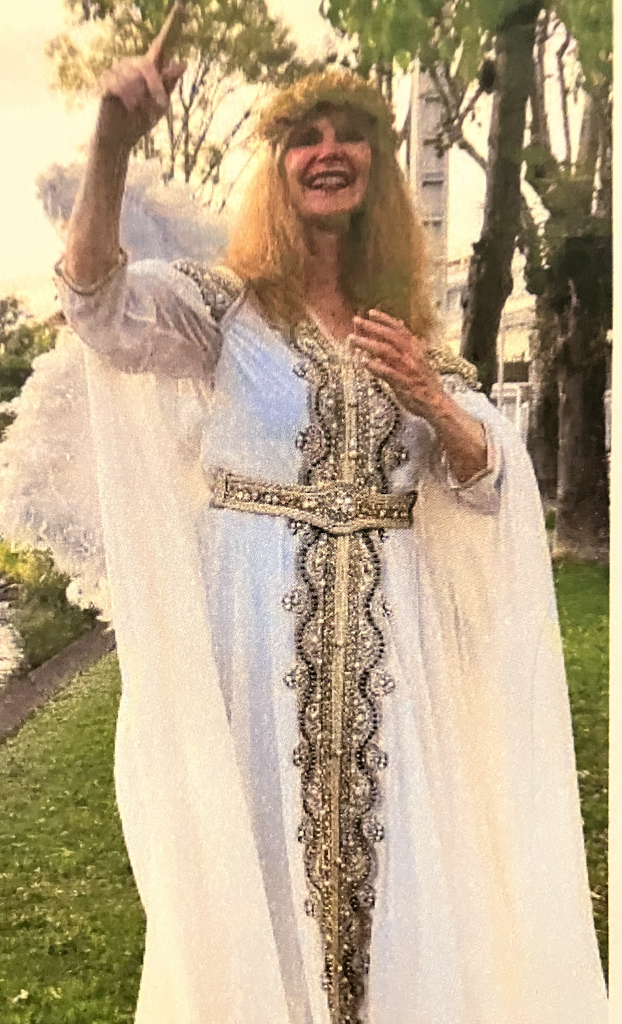
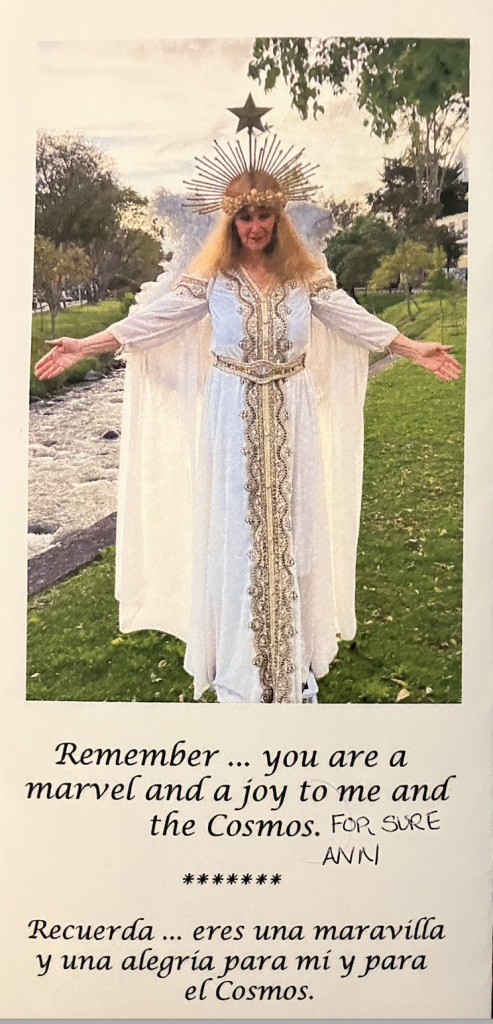
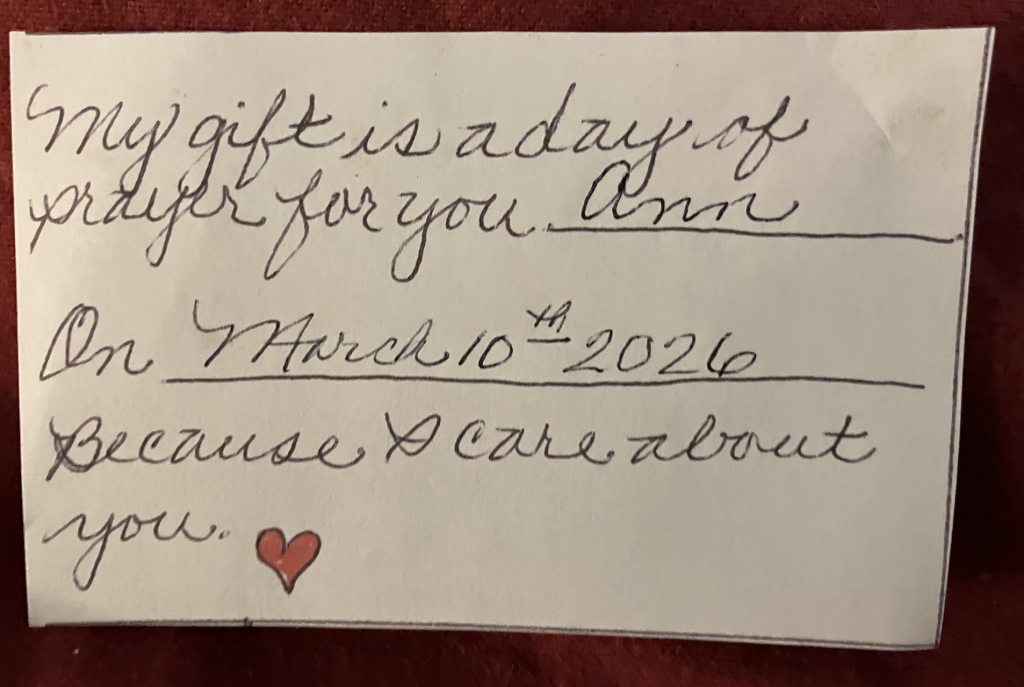
I called her, astonished. What a wonderful present! And to tell her that the day she had picked to pray for me, March 10, was my father’s birthday; and that I had been thinking of him over the past few days, savoring the fact that I now appreciate him even more than I had hated him back before I met Claudia.
I asked Janet: how many people do you send these presents to.
“Oh, about a hundred.”
“What? I don’t even know a hundred people.”
“Oh yes, you do.”
And she’s right. I do know at least a hundred people, or I did. I could reach out to each of them again, but have not; not yet. In any case, Have you ever heard of a more wonderful Christmas present?
Back in the early 1970s, when I was in my 30s, I was briefly married to my high school boyfriend. Dick had become the Editor of our local hometown newspaper. Marrying me brought him mostly private controversy — though I do remember writing a letter to the editor that took issue with “the news” that several people agreed with, in print.
What was bothering me: as I walked or biked around my home town, I had many experiences with others that I would call “good news.” My own experience made me realize that the world is full of good news, just as much as it is full of bad news. But bad news, my husband told me, is what sells. People are looking for the bad news, not the good news. Well, I wondered, why is that?
Here’s a post I wrote on the subject back in 1996.
Excerpts:
Here we are, decades later, near the end of 2025, and not much has changed. Or has it?
Actually, much has changed. Mainstream media is going downhill, fast. The internet has opened us to an infinity of points of view, which means: it’s up to each of us to decide what “news” we want to count, to reference, to amplify.
For me, three accounts on Twitter/X stand out at this point:
Mr PitBull
Crazy Vibes
Mr Commonsense
Each of these accounts tells stories, of strangers interacting with each other in magnanimous ways. And often, what someone does others notice, and then, as “one thing leads to another,” the original magnanimous action ends up blossoming into community.
Each of these stories warms my heart. I always repost them.
Now of course, some of these stories could be made up, not real. But I say, it doesn’t matter. Even imaginary stories like these help us grow into truly human beings, radiating love.
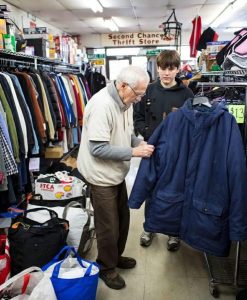
Here, for example, is one of Mr PitBull’s wonderful stories:
https://x.com/MrPitbull07/status/1994355106654159278
”And you? My teacher looked up, his left eyebrow arched, pencil poised. 'I want to do a paper on the concept of time.’” I mumbled, timidly. 'Time?' He sniffed. “I wouldn’t touch the subject. Too difficult.” — AK, 1967
Ph.D. 83
Astrologer, published author, conference presenter, world traveler, founder & editor of Crone Chronicles: A Journal of Conscious Aging (1989-2001) , and founding visionary of Green Acres Permaculture Village (2010 to present).
Copyright © 2025 All rights reserved.


[…] She sets the chart for Washington, D.C., which puts…